History Rhymes: Large Language Models Off to a Bad Start?
New York Times, Saturday, June 19, 1880
Welcome to a new CU series, History Rhymes, where I bring key perspectives from the distant past to bear on present events.
While mining old newspapers on a quiet Saturday – a hobby of mine - I came upon a story from June 19, 1880, that I found relevant to our modern anxieties about AI.
It is the story of Melville Ballard, who, as a child without language, spied with his eyes a tree stump and asked himself if the first man rose out of it.
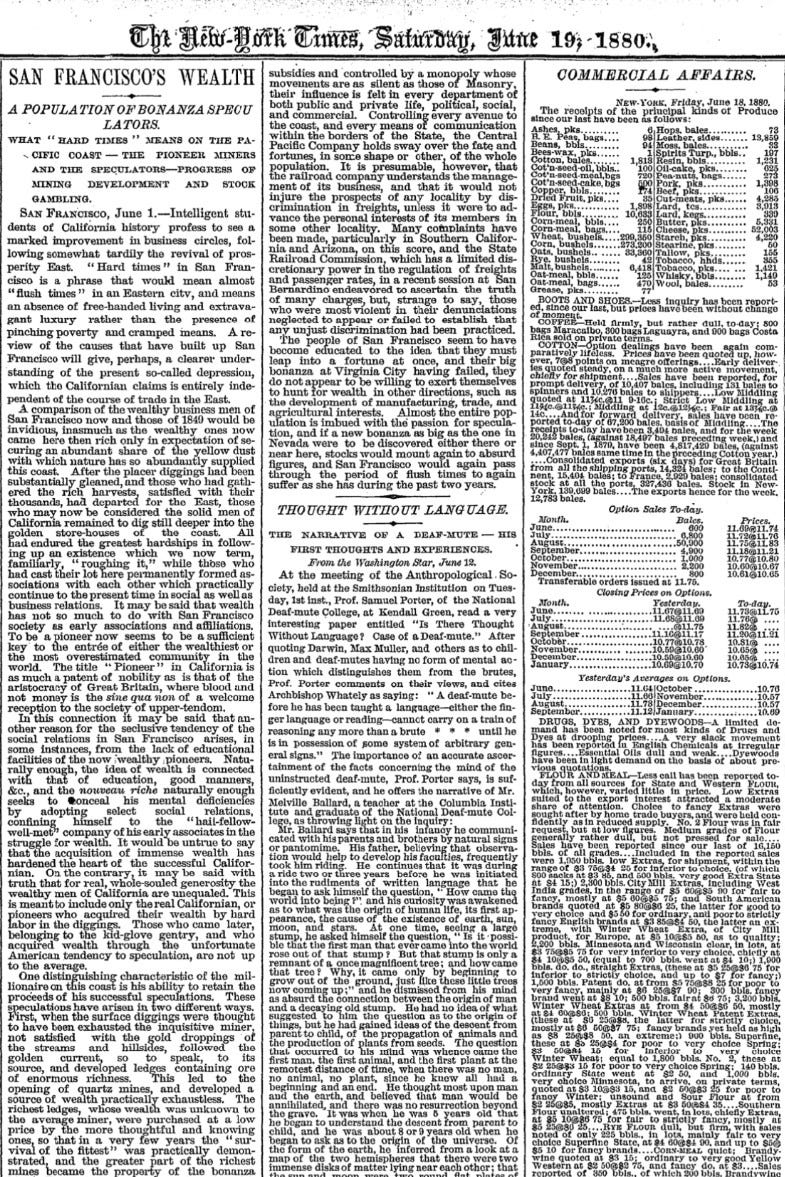
This 144-year-old case study – presented at the Smithsonian Institute no less - provides a potentially devastating critique of today’s Large Language Models and the spending behind them. With a simple human story, it boldly announced that complex thought exists in the silence before words.
Today, well into the 21st century, by putting language before the capacity for reason, we are not building intelligence; we are building an increasingly sophisticated mirror.
There are actually two stories of interest in that old newspaper. Let’s start with the one in the middle. This is Page 3 of this edition of the New York Times, and I see a story called Thought without Language.
Of course, Large Language Models, Small Language Models, and Reasoning are the topic du jour.
This the full story title is, “Thought without Language, The Narrative of a Deaf-Mute, His First Thoughts and Experiences.” As well, the story was originally published in the Washington Star on June 12, 1880.
The story concerns one Professor Samuel Porter, of the National Deaf-Mute College at Kendall Green, who presented a paper at the Smithsonian Institution. The paper title, “Is There Thought Without Language? Case of a Deaf Mute.”
At first discussion of deaf-mutes and children having no form of mental action that distinguishes them from brutes, well, understanding has changed a lot, and I was ready to dismiss.
The case study is of a teacher at the Columbia Institute for the Instruction of the Deaf and Dumb. This particular teacher, Melville Ballard, is also a deaf mute and a graduate of the National Deaf Mute College.
Mr. Ballard says that in his infancy he communicated with his parents and brothers by natural signs or pantomime. His father, believing that observation would help to develop his faculties, frequently took him riding.
He continues that it was during a ride two or three years before he was initiated into the rudiments of written language that he began to ask himself the question, “How came the world into being?” and his curiosity was awakened as to what was the origin of human life, its first appearance, the cause of the existence of earth, sun, moon, and stars. At one time, seeing a large stump, he asked himself the question, “Is it possible that the first man that ever came into the world rose out of that stump? But that stump is only a remnant of a once magnificent tree; and how came that tree? Why, it came only by beginning to grow out of the ground, just like these little trees now coming up;” and he dismissed from his mind as absurd the connection between the origin of man and a decaying old stump.
He had no idea of what suggested to him the question as to the origin of things, but he had gained ideas of the descent from parent to child, of the propagation of animals and the production of plants from seeds.
The question that occurred to his mind was whence came the first man, the first animal, and the first plant at the remotest distance of time, when there was no man, no animal, no plant, since he knew all had a beginning and an end. He thought most upon man and the earth, and believed that man would be annihilated, and there was no resurrection beyond the grave.
It was when he was 5 years old that he began to understand the descent from parent to child, and he was about 8 or 9 years old when he began to ask as to the origin of the universe. Of the form of the earth, he inferred from a look at a map of the two hemispheres that there were two immense disks of matter lying near each other; that the sun and moon were two round, flat plates of illuminating matter, for which he entertained a sort of reverence, and thought from their coming up and going down that there must be a certain something having power to govern their course.
He believed the sun went into a hole at the west and came out at another at the east, traveling through a great tube in the earth, descending the same curve as it [the sun] seemed to describe in the sky. The stars seemed to be tiny lights studded in the sky. He relates how vainly he endeavored to comprehend this subject until he came to school, at 11 years of age.
Before this he had been told by his mother that there was a mysterious being up in the sky, but when she could not answer his questions he gave it up in despair, feeling sorrowful that he could not obtain a definite idea of the mysterious living one up in the sky.
For a year after his admission into the school for deaf-mutes, he learned a few sentences every Sunday, and though he studied these simple words, he never acquired any idea of them. He attended the chapel services, but they were almost unintelligible, owing to his imperfect knowledge of the sign language as employed in the institution. The second year he had a small catechism, containing a series of questions and answers.
The development of understanding through the application of language to the capacity for reason continues.
He was now able to understand the sign language employed by his instructors. It may be said that his inquiring disposition ought to have been satisfied. It was not so; for when he had learned of the creation of the universe by the one great ruling Spirit, he began to ask himself, Whence came the Creator? and set himself to inquiring after His nature and origin. While he revolved this question he asked himself, “Shall we ever know the nature of God and comprehend His infinity after we enter His kingdom?” and would it not be better for us to say, with the patriarch of old, “Canst thou by searching find out God?”
Professor Porter then lets the hammer fall, as it were, on that 1880 Smithsonian Institute audience.
Prof. Porter discusses this case, and notes that brutes may understand some words, tell some objects from others, etc. He says: “Allowing to the brutes the utmost that can be claimed for them, is it not still plain that man has faculties which we cannot conceive as developed out of, or as simply exaltations in degree of, anything that he possesses in common with the lower animals.
* * * Whatever may be the similarity in the way in which the impressions are produced or in the structure of the organs, and whatever may be the dependence upon organic action—that is to say, however they may be allied physiologically—yet as sensations or perceptions, those of the eye are different in themselves and imply a special gift or power not implied in those of the ear, or the head, or the tongue. It is not thus with the acts of the reason as compared with the working of the lower faculties.
* * * That the two have some elements in common does not prove them to be throughout of the same order or render it possible for one to be developed out of the other. And if the eye of the soul, the higher reason by which we look through the universe of things, cannot look in upon itself and clearly discern its own nature and processes, we ought not, therefore, forgetting what it does, to deny its essential superiority and to assimilate it to those lower and subsidiary faculties which we can bring under its scrutiny. That by which we understand all things must be essentially superior to anything else that is understood by it.
One of the presentation’s attendees notes, significantly, how Ballard’s eyes conveyed meaning perfectly, without misunderstanding, above all else.
One of the most interesting features of this meeting was Mr. Ballard, by signs, explaining how his mother informed him that he was going a long way to school, where he would read from a book, write and fold a letter, and send it to her, &c., and also, by pantomime, reciting how a hunter, after killing a squirrel, accidentally shot and killed himself. Mr. Ballard’s signs and gestures, with the expression of the eyes and face, conveyed his meaning perfectly to the audience, and, in the words of a member, the expression of the eye was language which could not be misunderstood.
Let us consider these two statements:
“That by which we understand all things must be essentially superior to anything else that is understood by it.”
“…in the words of a member, the expression of the eye was language which could not be misunderstood.”
In sum,
Language without the Capacity for Reason fails at Understanding
Only with Capacity for Reason does Language unlock Understanding.
Understanding, fully realized, transcends Language.
By putting language first, LLMs build a primitive form of reason purely through logical inference, but this form of reason has been shown flawed and prone to hallucination due to limitations at the many ragged edges of knowledge.
The capacity for reason never existed. Therefore, language cannot scale through reason to understanding.
The professor suggests, in his work with deaf and mute people, he has discovered that a capacity for true reason must exist first, before language, so language can unlock understanding — the product of that capacity for true reason and language.
“The expression of the eye is the language which cannot be misunderstood.”
To wit, expression of the eye is what flawless understanding looks like, without the need for language.
Large Language Models, by putting language first, before the capacity for true reason, can never attain understanding.
If understanding truly transcends language, as this 144-year old presentation at the Smithsonian, suggested, we should find evidence of it rather easily today.
I can personally relate this to the study and practice of medicine. All through undergraduate premed classes and through much of medical school, deductive logic is the means by which the student organizes the vast field of medicine. Through the clinical years the art of medicine, the physical manifestation, the emotion, the human expertise is developed. And then, at some point during residency or early in the physician’s career, with volume involving all of the above, understanding is reached. All the parts connect together in a vast, complex web that allows expert complete patient care.
Two surgeons working a difficult head and neck cancer or trauma, or the nurses that work with the doctors, can at times communicate purely with their eyes, and full understanding is transmitted, actions taken because all parties involved have attained understanding, transcending logical inference and other primitive forms of reason, such as the memorization and puzzle-building of the early education of a health care professional.
The eye then provides the intuitive grasp of reality based on mutual understanding, which proceeded from the capacity for reason in the presence of language.
The Large Language Model, as well the Small Language Model, lives permanently in the middle. It can simulate reason, but without true capacity for reason, without eyes, without understanding.
This is a known flaw, a bad start. The original approach to AI was to generate a true capacity for reason first, but it was never realized, and the field pivoted to language first because it was easier.
This ‘bad start’ has led to a “parameter trap,” where brute-force language processing powered by zillions of power-hungry chips has become an incredibly ironic bottleneck.
As my conversation with Klarna’s Sebastian Siemiatkowski highlighted, the future lies in compression—leveraging ‘System 2’ reasoning-first to work off the redundancy of information and the relatively finite query sets produced by humans to drastically reduce compute needs.
This new line rejects singularity through language models talking to each other in an infinite mirror as a directionless waste of resources made impossible by lack of a basis in economic realities.
While frontiers like Google’s AlphaGeometry and Meta’s Coconut are finally moving toward this ‘reason-first’ architecture, they are essentially rediscovering what was presented at the Smithsonian 144 years ago: that language is the output of understanding, not the engine of reason.
This multi-trillion dollar scaling myth may be rendered redundant by a return to the silence of pre-linguistic reason, the full-bandwidth capacity for reasoning of the deaf mute, whose silent thoughts reached for heaven’s stars before ever finding the words for them.
Silly Valley
Now, I mentioned there was another story of interest, and it is on the same page. More relevant to the first story than anyone in 1880s may have guessed it would be in 2026.
This article is “San Francisco’s Wealth, A Population of Bonanza Speculators.”
This story was written June 1 in San Francisco, and only published in the New York Times on June 19th.
The French saying, “the more things change, the more they stay the same,” comes to mind.
“Hard times” in San Francisco is a phrase that would mean almost “flush times” in an Eastern City, and means the absence of free-handed living and extravagant luxury rather than the presence of pinching poverty and cramped means.”
California was pre-eminently the paradise of the man of small capital. To satisfy the craving for speculation, the peculiar open-board system was adopted, whereby the man who had $50 to invest, by purchasing a share therein, could acquire a small interest in a mine at a dollar a share, or two shares at 50 cents, or any number at varying prices.
A “boom” existed here in certain stocks, seemed not to reach beyond the desire to do so “just once more” it seemed to excite the same gambling fever in San Francisco, and for lines lost by the bonanza firm was eagerly grasped by the people of San Francisco, and of the “boom” having been accompanied and by speculative losses on the part of the people, the “boom” disappeared and stocks fell to their normal condition.
The story closing hits hard for reality today.
The People of San Francisco seem to have become educated to the idea that they must leap into fortune at once, and their big bonanza at Virginia City having failed, they do appear to be willing to exert themselves to hunt for wealth in other directions, such as the development of manufacturing, trade, and agricultural interests. Almost the entire population is imbued with the passion for speculation, and if a new bonanza as big as the one in Nevada were to be discovered either there or near here, stocks would mount again to absurd figures, and San Francisco would again pass through the period of flush times to again suffer as she has during the past two years.
In The Cardinal Sign of a Bubble, Supply Side Gluttony, I outlined this remarkable tendency, originating in the San Francisco Bay Area, for speculation rising to levels that spur investment far, far beyond that needed for end demand in any timely dimension.
Reading old newspapers like this provides the perspective to interpret today’s events in a differentiated manner. Whether Silicon Valley will “again pass through the period of flush times to again suffer,” as she has repeatedly, or improbably break the pattern, I hope you found this helpful.
Finally, I must recommend midjourney, a tool for creating images and videos, to readers.
It is just so much fun, and makes one think. Be creative!
Until Next Time!


Hi Dr. Burry, this is quite the find! I keep coming back to current LLMs being interpolation machines that will be asymptomatically limited by current written understanding.
Hi Dr. Burry,
Brilliant piece and thank you for sharing this article as well as your first hand account of the training and development of a doctor.
This triggered a recollection of my Princeton undergraduate experience in the mid-70’s. At the time, I was intrigued by a small group of PhD students that were in a field called the History of Philosophy and Science (and had the privilege of sitting in on a handful of classes).
It was headed up by the legendary Professor Thomas Kuhn. The message you just described in your piece was frankly the nature of what Professor Kuhn studied.
Briefly stated, his work as applied to LLM’s goes as follows (help here from a long series of prompted questions from me to Gemini AI):
The Incongruity: Human Consciousness vs. AI
Applying Kuhn's brilliance to today’s Large Language Models (LLMs) reveals a fundamental gap:
Syntax vs. Semantics: AI operates in a closed loop of "Lexical Taxonomies" (Kuhn’s term). It maps the relationship between words but lacks the "exemplars" (lived experiences) that give those words meaning.
Incommensurability: There is an unbridgeable gap between the statistical prediction of a machine and the spiritual presence of human thought. One is a calculation; the other is a "gestalt switch" or a "conversion."
The Lack of an "I": Kuhn’s work emphasizes that science is a human, social activity. An AI lacks the "subjective self" required to experience a crisis of thought or a revolutionary insight. It cannot "see" a duck as a rabbit; it can only calculate the probability of both.
The "miracle of human thought" I recall from my undergraduate days remains the missing ingredient in modern AI. Kuhn’s work suggests that while we can build a perfect "lexicon" (AI), we cannot build the "practitioner" (the Soul) who uses that lexicon to reach for the truth.
Dr. Burry, I applaud you for sharing the touching, thoughtful and inspiring article, your medical education and experience, and ultimately the window to the soul.