
Foundations: My 1989
My years as a Silicon Valley techie immediately before the internet

This past weekend, I came across a great interview of Marc Andreessen, conducted by his partner Ben Horowitz.

These are the two founders of a legendary VC firm. More importantly, they were pioneers in the early internet, and Marc Andreessen discussed his history with Mosaic and Netscape.
I found it fascinating, and it stimulated my own memory of that time.
My 1989 got started in 1987. As a founder of the Santa Teresa High School Computer Science Club, I completed an AP Computer Science course, learning Turbo Pascal within the text-only environment of MS-DOS.
Coming out of high school, I won an IBM Thomas J. Watson Scholarship, which would cover my registration fees/tuition at UCLA, and then some, and guaranteed all my summers during college would be spent insided R&D at IBM’s Cottle Road and Almaden Research Center locations.
This had been the birthplace of the hard disk drive decades earlier.
That internship started the very first summer before heading to UCLA. 1989.
My job involved stress-testing head disk assemblies by injecting contaminant into full HDAs, tracking and recording failure, then disassembling to examine 14-inch golden disks with ferric oxide thin film coating for physical evidence of failure.
Yes, those 14 inch disks were where memory was stored. A truly hard disk drive. Each weighed maybe a pound and were as thick as a 4 or 5 vinyl records.
This was the deliberate destruction of IBM’s most expensive hardware. When and where the failure occurred – which disk, and where on the disk – were the important parts.
I earned $7.425/hour, a big step up from my $2.85/hour high school gas station attendant job. I worked weekends, nights, holidays in a windowless room. I was very cognizant of the time-and a-half and even double-time I earned working so late and so long.
I loved making real money.
My bench space in the lab had an IBM 3270-family terminal running Virtual Machine/Conversational Monitor System (VM/CMS). I collected my data with pencil and graph paper, and I used APL, which stood for A Programming Language, to enter the data and analyze it. APL basically allowed matrix math to be performed with fairly rote short lines of code.
APL required a special keyboard which was about as clunky as the old IBM Selectric Typewriter keyboards. Looked like this:
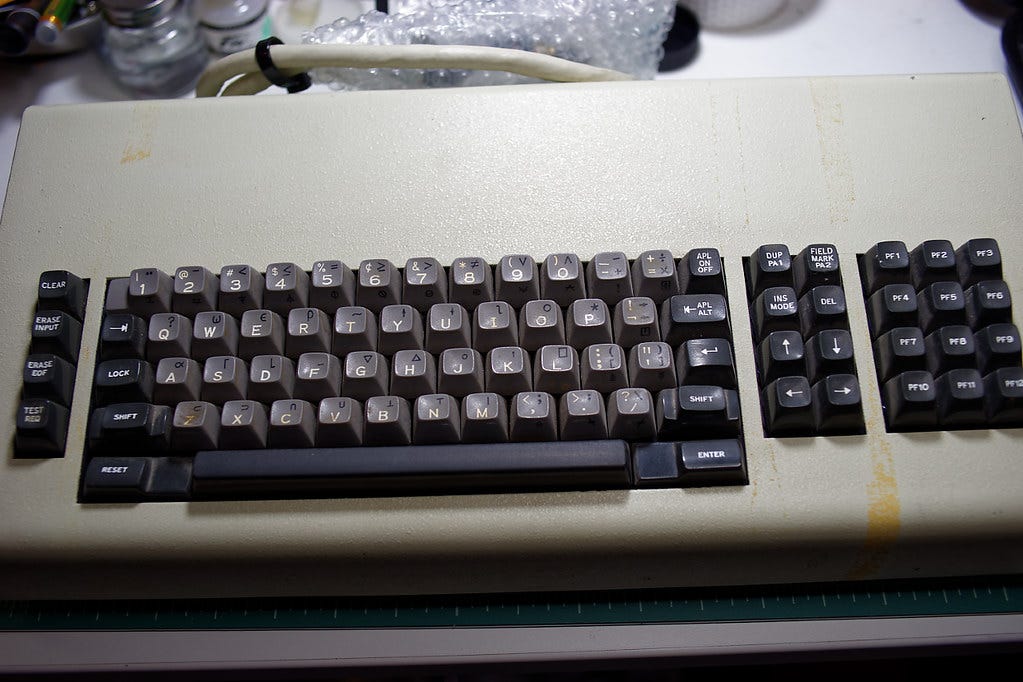
That was my only keyboard. I communicated with others on an internal IBM messaging system which was like an early email.
I did not complete Matrices & Differential Equations until my sophomore year of college, but it was an easy A when I got there.
I would help German PhDs with their experiments when I was not doing this HDA failure analysis. There were a lot of German PhDs working at the IBM in San Jose at the time.
It felt like there was a lot of theoretical work being done that had no practical purpose.
I learned that IBM back then had 18 levels of management. Our 10,000 person, 190-acre campus on Cottle Road was run by a 3rd level manager. There were 15 levels above him. Legendary bureaucracy and aimless paper-pushing. CEO Akers would communicate a message to all employees now and then through closed circuit television.
It was an extremely busy, lively campus with a central cafeteria that had great food. The campus included a couple manufacturing buildings as well, and I got to know a number of people there.
It was a great environment. Felt like a small city or town within the subdivisions built on top of old orchards. At that same time, Silicon Valley was growing all around us. It felt natural to push boundaries and see what was next.
At one point, the failure testing I was doing needed to be done under time pressure with little time for analysis. It was put on paper and then apparently literally flown to be presented to CEO Akers. I had a number of white haired men looking over my shoulder for hours as we waited for IBM’s premier storage product to fail.